The Star That Punches In Before Anyone Else: One Year of Backyard Sky-Watching
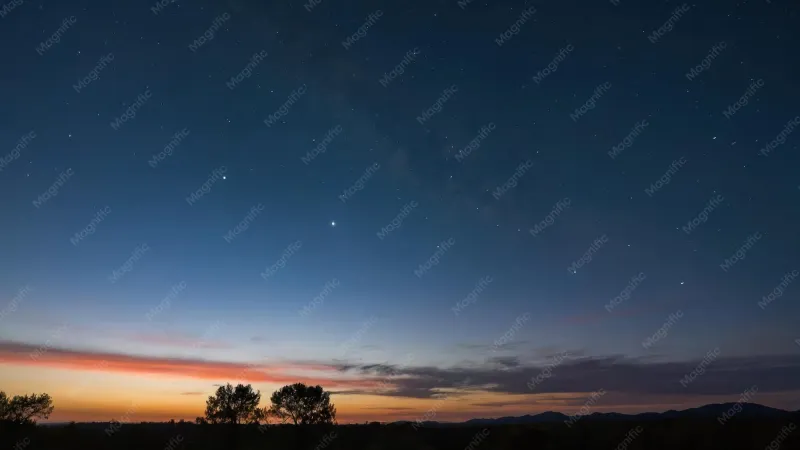
Photo: first star at dusk over midwest backyard twilight sky, via img.freepik.com
The Night I Almost Missed It
It started on a Tuesday in March, the kind of gray Ohio Valley evening where the sky can't decide between rain and sleet. I'd just gotten off a phone call that ended a job I'd held for nine years, and I didn't want to go inside. So I stood in the backyard, coffee gone cold in my hand, and waited.
And then it happened. A single point of light, low in the western sky, before anything else had the nerve to show up. The first star. The opener. The Aleph of the evening — the first letter of a story the sky writes fresh every single night.
I decided, somewhat impulsively, to meet that letter every night for a year. I didn't know it then, but I'd just signed up for the cheapest therapy in the Midwest.
What Counts as "First"
Quick astronomy detour, because it matters: the first star you see at dusk usually isn't a star at all. It's often a planet — Venus, most famously, or Jupiter playing the role. Sailors and shepherds have known this for centuries. The brightest early light is frequently an impostor.
Here's the thing, though: it didn't matter. The ritual wasn't about astronomy purity. It was about showing up for the moment the sky changes its mind — that narrow window when day officially loses its argument and night takes the podium. Some nights the first light appeared in under a minute. Other nights, heavy cloud cover made me wait twenty, forty minutes, squinting at nothing, doubting the whole enterprise.
That's the part nobody tells you about rituals. They're not really about the sky. They're about what you do when the sky doesn't cooperate.
The Logbook in the Kitchen Drawer
I kept a spiral notebook on the back porch — nothing fancy, the kind you buy in a three-pack at a drugstore. Each entry was one line: date, time, direction, weather, and whether I'd found the first light.
By June I'd noticed something embarrassing. I had opinions about clouds now. I'd developed a grudge against the neighbor's giant maple, which blocked half my western view. I'd learned the names of constellations I couldn't previously have picked out of a lineup — Arcturus, Vega, that steady orange beacon that shows up fashionably early all summer.
More than that, the notebook became a record of a year I almost didn't notice I was living. The night my dad went into the hospital, the entry just says "9:41 pm, east, finally, clear." The night my daughter left for college, I wrote "found it before I looked up." I don't fully know what that means. I've decided not to over-explain it.
Small Rituals, Real Doors
We talk a lot on this site about keys and doors and first letters — the idea that every beginning has a lock, and small consistent acts are how we find the keys. A year of star-watching taught me the practical version of that idea:
The ritual has to be laughably small. Two minutes, tops. If your new habit requires a cushion, a candle, and forty minutes of silence, you'll quit by the second week of February. My entire practice was: step outside, look up, wait.
The reward has to be uncertain. Some nights the star came instantly. Some nights it didn't come at all. That unpredictability is exactly what kept me coming back — the same mechanism that makes slot machines ruinous and baseball season beautiful.
The ritual should mark a threshold. Evening is a hinge. Whatever happened at work, in the inbox, in the group chat — the first star is the sky's way of saying that file is closed; a new one is open. I started treating it that way. Not a productivity hack. A permission slip.
Second Chances, Distributed Nightly
There's a reason so many traditions treat the day as beginning at sundown rather than sunrise. It reframes everything. The evening isn't the end of your day — it's the start of the next one. Miss a deadline? Botch a conversation? The first star doesn't care. It punches in anyway, right on time, like it always has, offering the same deal it offered last night: we can try again.
I finished the year in late winter, standing on the same patch of grass, watching the same kind of small light arrive on schedule. The notebook is full. The job is different. The maple still blocks the view, and honestly, I've made peace with it.
I still go out most nights. Not because I have to. Because somewhere between day and night, there's a door that only opens for people who bother to stand in front of it — and the key, it turns out, is just showing up and looking up.
The first letter is always there. You just have to read it.