No Map, No Errands, No Idea: My Week of Walking in Circles
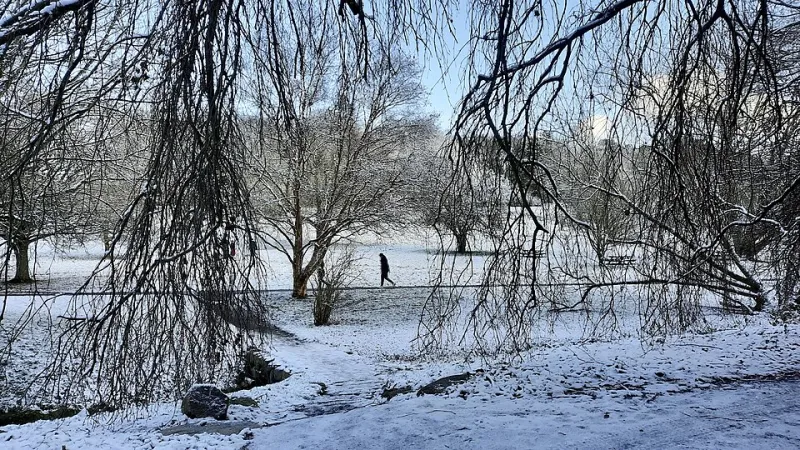
Photo: Ciara Ní Riain, CC BY-SA 4.0, via Wikimedia Commons
There's a moment on every walk when you hit the edge of your plan. The coffee stop. The loop around the park. The errand dressed up as exercise. And usually, right there, you turn around and go home.
For one week last October, I didn't turn around. I walked without a destination — no phone in my hand, no map, no list of things to pick up. Just shoes, a jacket, and whatever the neighborhood wanted to show me. This is what happened.
The Rules of Getting Lost on Purpose
I kept it simple. Leave the house. Walk. When you feel like turning back, keep going one more block. No podcasts, no calls, no "just checking" the route. If I recognized where I was, fine. If I didn't, better.
Day one was embarrassing. My legs kept asking, okay, where are we going? And I had no answer. It turns out I've spent years outsourcing my walking to my calendar. Every stroll was secretly a commute.
By day three, something shifted. The question stopped being "where am I going?" and became "what's over there?"
What the Flâneurs Knew That We Forgot
The French had a word for this — flâneur, the idle wanderer who reads the city like a book. It sounds fancy, but Americans used to do it too, without the vocabulary. We sat on front porches. We strolled to the corner store not for the milk but for the seeing and being seen. Small-town Main Streets were built for drifting.
Somewhere between the porch and the smartphone, we lost the drift. Walking became a workout metric. Ten thousand steps, tracked, optimized, completed. But a step count is not a walk. A walk is a conversation with wherever you happen to be.
The mystics figured this out long before the flâneurs. Wandering is one of the oldest spiritual technologies we have — the desert fathers walked, pilgrims still do, and every tradition that prizes the journey over the arrival is really saying the same thing: you can't unlock a door you never walked past.
The Doors You Only Find When You're Not Looking
Here's what a week of aimlessness actually produced:
- A conversation with a retired mail carrier who told me which houses on his old route had the friendliest dogs — and the friendliest widows.
- A community garden tucked behind a Methodist church that I've driven past maybe two hundred times without ever seeing.
- The smell of someone's grandmother's cooking drifting out a window at dusk, which unlocked a memory of my own grandmother's kitchen that no amount of intentional remembering could have reached.
That last one is the real point. Wandering isn't about the streets. It's about what the wandering shakes loose. When you stop telling your brain where you're going, it stops filtering what it shows you. The past, the neighbors, the light hitting a porch swing at 5:40 in the afternoon — all of it comes online.
Planners ask, "What do I want?" Wanderers ask, "What's here?" Those are different questions, and only one of them has an answer you didn't already know.
A Week of Structured Aimlessness, Graded
Did every day deliver? No. Day two was cold and boring and I mostly thought about lunch. Day five I got genuinely lost and had to swallow my pride and check my phone — which felt, honestly, like quitting a fast.
But by day seven, the walks had changed me in small, stubborn ways. I was slower to reach for the phone generally. I noticed front doors — really noticed them, the colors, the wreaths, the keys left in locks. I started understanding my town as a place with a shape instead of a route with stops.
There's a reason the first letter of the alphabet is also the first letter of aim. We've been taught that everything begins with a target. But maybe everything worth finding begins with the opposite: an open hand instead of a pointing finger. A. Alef. The start of the alphabet — and, some say, the start of everything — is a silent letter. You don't say it. You let it be.
Wandering works the same way. You don't announce it. You don't measure it. You just walk out the door and let the world take its turn leading.
Try It Before You Decide It's Nonsense
You don't need a week. Try one walk. Twenty minutes, no destination, no destination even in your head. When your brain demands to know the plan, tell it the plan is the question.
The doors we find while drifting — the garden behind the church, the neighbor with the stories, the memory in a stranger's kitchen window — don't show up on maps. They only open for people who weren't in a hurry to be somewhere else.
The lock was never on the door. It was on the itinerary.